Building Indigenous Future Zones:Four Tribal Broadband Case Studies
About the Fond du Lac Band
The Fond du Lac Band is one of the six bands of Ojibwe, which together are federally recognized as Minnesota Chippewa. The Ojibwe have lived in the Great Lakes area for more than a thousand years. The La Pointe Treaty of 1854 established the Fond du Lac Band’s reservation in Carlton and St. Louis County, Minnesota. The reservation is known as Nagaajiwanaang, “where the water stops.” There are more than 4,000 people in the Fond du Lac Band.14 They operate two casinos, Black Bear Casino Resort and Fond du Luth Casino. Fond du Lac also operates FDL Gas & Grocery, FDL Propane, and FDL Sand & Gravel as tribal enterprises.
Brief History of Aaniin Fiber Services
Aaniin was built through years of careful research and feasibility studies. Jason Hollinday, the Director of Planning at Fond du Lac Planning Division, explained how the Fond du Lac Band approached the problem of getting high-speed Internet service throughout their communities. In 2006, they started to compare wireless and hardwired network types, such as cable and fiber. The original plan called for ten wireless towers throughout the reservation to deliver Internet service to people’s homes. There were a number of issues with this plan, however, one of which was geography. Northern Minnesota has many hills and forests, and the wireless technology at the time was not going to be able to penetrate to many remote areas. It was, however, fairly inexpensive, and Fond du Lac moved forward with seeking grants for the project. They weren’t funded and Hollinday says they were told that the project was “economically infeasible.”
Undaunted, they changed tactics and considered alternatives, allowing them to be prepared when the market changed drastically in 2010. The price of fiber and equipment for a Fiberto-the-Home network fell enough to make a network feasible on paper. They worked with the Blandin Foundation in Minnesota and pursued grants through the USDA. Community members, however, needed Internet service faster than the fiber network was likely to be built. The Fond du Lac Band already had an institutional network between government buildings. They added 13 wireless hotspots to several of these buildings in 2013. The hotspots have a range of about . mile, and still serve as a stop-gap measure for community members without reliable Internet service at home.
In 2015, they were finally awarded a USDA Community Connect Grant. Two Minnesota Border to Border Broadband Grants were later approved as well and one Housing & Urban Development (HUD) Indian Community Development Block Grant. In total, it was about $9 million in grants, and the Fond du Lac Band matched half that amount with $4.5 million in cash on hand. They had secured all the funding needed to build out a next-generation network.
Starting out, some of the grants required them to build to areas without Internet service of at least 10 Megabits per second (Mbps) download and 1 Mbps upload. Unserved areas were prioritized. Later grants supported building the network to areas without 25 Mbps download and 3 Mbps upload. This enabled the Fond du Lac band to reach the rest of the reservation. The Blandin Foundation had assisted with community outreach about the project. In a series of public meetings, community members talked about what they would like to do with the Internet service. Hollinday described a little bit of doubt from some members, such as “Well we’d never get that here, but if we did have it…,” because the project sometimes seemed too good to be true. The network went live in Fall 2019.
The network, however, continues to expand across the reservation, connecting more people. People are still learning all the capabilities of the Internet service. Since 2014, Fond du Lac has offered a summer camp for teens to create smartphone and iPad apps. Each student creates an app and is given an iPad to take home. The program also supports cultural knowledge. For instance, some of the apps from 2014 went into detail about beading, plants, and the Ojibwe language.15 The possibility of expanding outside of the reservation boundaries has been considered, but the focus right now is on making sure all community members have access to a reliable connection. Using gaming money and possibly further grants to build a fiber network in nearby areas could create a long-term diversified revenue stream for the community.
Network Details
Population Served
Hollinday shared that there are 510 accounts for customers, which he explained as being approximately 1500 - 2000 people. There are about a dozen businesses connected to the network, not including home businesses.
Prices & Speeds
There are three service options currently available: Essential Home, Advanced Home, and Automation Home. Essential Home provides basic Internet Service, and the prices listed below include a $13 equipment rental fee.
The Advanced Home service costs an additional $8 monthly (starting at $75.95) and includes a mobile app to manage the network and parental controls.
The Automation Home option is designed for automating the home. It starts at $86.95 a month for 50 Megabits per second (Mbps) (an additional $19 more than the Essential Home service). It includes an Amazon Alexa and a home automation hub.
A lower cost option called Essential Flats, starting at $60.95, will be introduced at the end of 2020 for apartments.
Funding
The network cost about $13.5 million in total. About $9 million came in the form of grants from a USDA Community Connect grant, two MN Border-to-Border Broadband grants, and a HUD Indian Community Development Block Grant. The Fond du Lac Band contributed $4.5 million in funding up front.
Expansion Plans
Hollinday said that they are still working to bring the network to the entire reservation, but they may later consider expanding into neighboring communities.
Managing and Setting Up the Network
COVID-19 has created increasing demand for Internet service, which so far has not strained the network. They are focusing on problem-solving issues common to any new network, such as improving customer service and adjusting to problems on the fly. For the first year of operation, they contracted out customer service, but if the problem is something physical, there are a couple of crews on call that will go out to fix it.
Takeaways for Other Native Nations
Hollinday found the key to Aaniin’s success was a combination of background research and public outreach. Before embarking on this project, the Fond du Lac Band had spent years digging into what would make sense in their community. They had considered multiple avenues to bring Internet service to remote areas and had weighed the full cost of building a network. They also made sure to fully include the community in their project. Working with the Blandin Foundation, they held public meetings to learn what the community members wanted and designed the network to meet their expectations.
Doing background research and involving the community early in the process are all forms of pre-planning, steps taken before officials decided to pursue a specific course of action. All of these forms of pre-planning are useful for filling out grants. It creates a clear narrative that grant agencies can follow to see how an Internet service project will impact the community. Hollinday credits this pre-planning as “the difference between applying for early grants and now.”
When the Fond du Lac Band had first applied for broadband grants in the mid-2000s, the Planning Division had not done as much pre-planning. They knew that their community needed Internet service and that the wireless project made the best economic sense at the time. But without pre-planning, they were not able to communicate that to grant agencies. When the market changed in 2010, the Planning Division realized Fiber-to-the-Home was actually feasible. They did more background research and involved the community. This showed grant agencies a clear narrative of why the community needed Fiber-to-the-Home.
About the St. Regis Mohawk Tribe
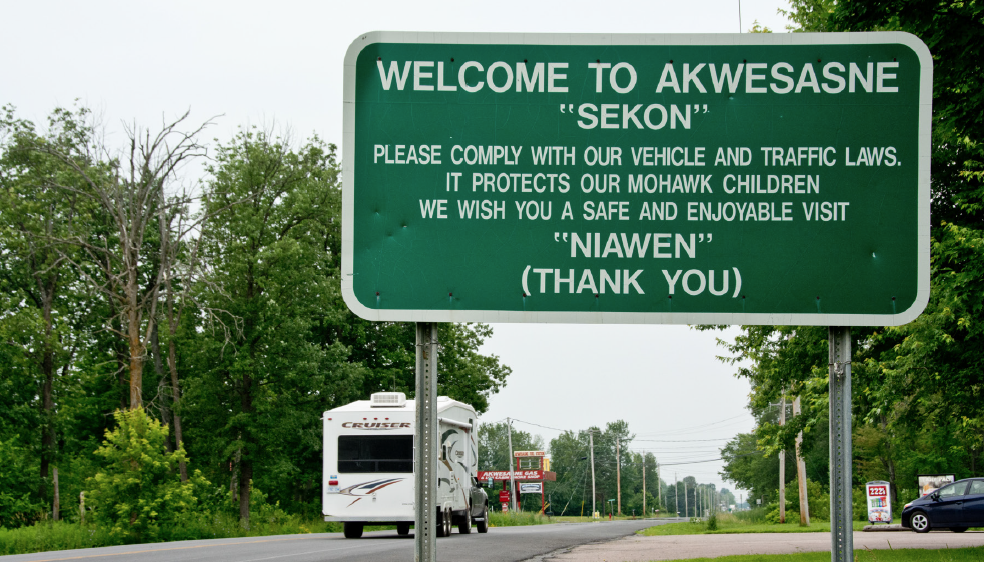
The St. Regis Mohawk Tribe is a single community, known as Akwesasne, meaning “land where the partridge drums.”17 It is crossed by the Canada-United States international border (New York - Quebec/Ontario), but tribal members are able to freely cross this settler-colonial border under the terms of the Jay Treaty of 1794. Both the United States federal government and the New York State government have separate government-to-government relationships with the St. Regis Mohawk Tribe. The community is home to about 1500 households. There are three tribal enterprises: the Akwesasne Mohawk Casino Resort. Akwesasne TV, and Mohawk Networks.
Brief History of Mohawk Networks
Mohawk Networks started out as an idea in the mid-2000s to provide everyone in the community reliable Internet access. It took close to a decade to determine the best project plan and to secure funding. This was one of the first fiber networks to be built by a Native Nation using funding from the American Recovery and Reinvestment Act (ARRA). Mohawk Networks uses both Fiber-to-the-Home and fixed wireless to connect everyone in the community.